Condition Deep-Dives 11 min read·Updated 22 July 2026 Clinician-reviewed

Calciphylaxis (Calcific Uraemic Arteriolopathy)

A UK Consultant Nephrologist on calciphylaxis — small-vessel calcification of skin arterioles in dialysis patients, with devastating necrotic ulcers and one of the highest mortality rates in nephrology. Early recognition, warfarin withdrawal and sodium thiosulfate are critical.

  • Clinically Reviewed
  • NHS & NICE Aligned
  • UK Evidence-Based
  • Last Reviewed 22 July 2026

Professor Mohammed Mahdi Althaf

Consultant Nephrologist & Acute Physician

View Credentials

Professor Mohammed Mahdi Althaf

MD, MSc, PgDip (Clin Ed), FRCP, FHEA, FASN

Consultant Nephrologist & Acute Physician · GMC 7216325

View profile →

Direct answer

Calciphylaxis: small-vessel calcification → necrotic skin ulcers in dialysis patients. Painful retiform purpura on adipose-rich sites. Stop warfarin, switch to DOAC, control PO4 and Ca, IV sodium thiosulfate 25 g × 3/week post-HD. One-year mortality > 50% — early palliative input is appropriate.

Key recommendation: Painful retiform purpura → necrotic ulcers in HD patients.

Quick answer

✓ Best choices

  • Fresh, unprocessed foods cooked at home
  • Plant proteins: tofu, beans, lentils in measured portions
  • Lower-phosphate cheeses (mozzarella, cottage cheese) in small amounts

✓ Foods to limit

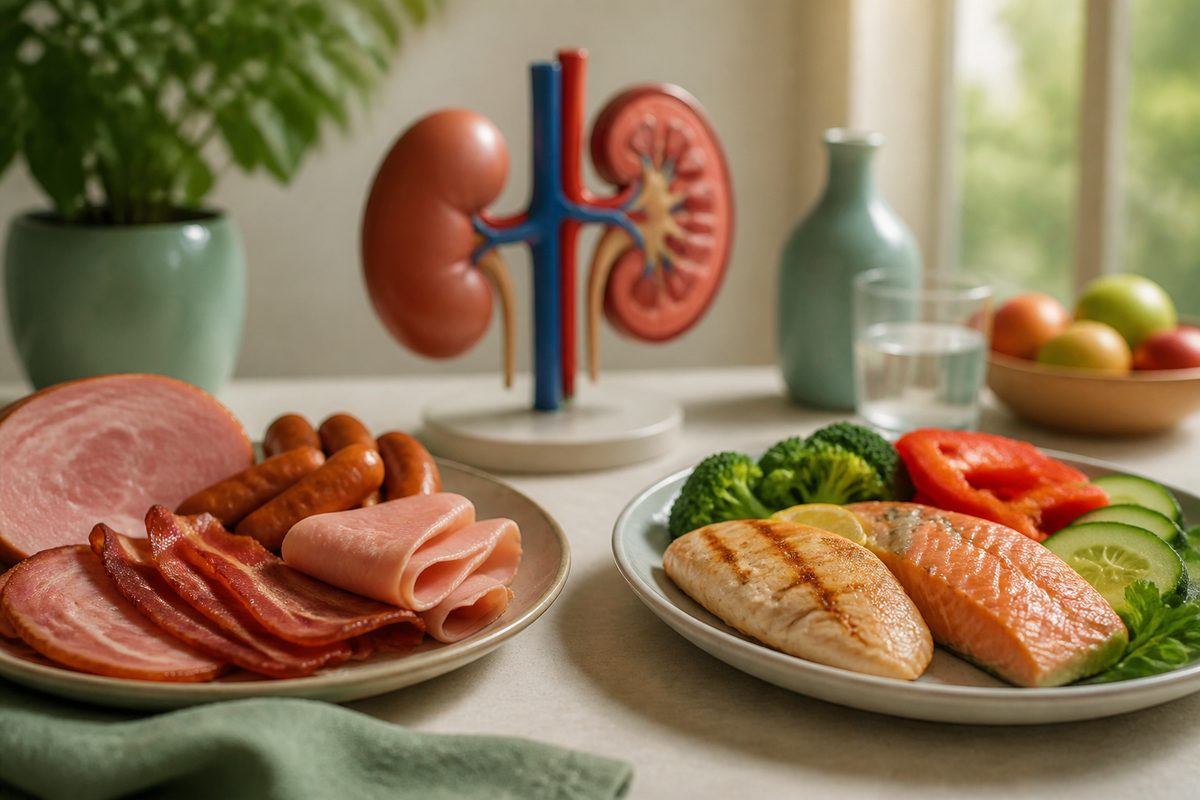
  • Processed meats (bacon, ham, sausages, deli slices)
  • Cola and dark fizzy drinks
  • Instant noodles, ready meals, processed cheese, milkshake powders
  • Any food with E338, E339, E340, E341, E343, E450, E451, E452 on the label

Key takeaway

Calciphylaxis: small-vessel calcification → necrotic skin ulcers in dialysis patients. Painful retiform purpura on adipose-rich sites. Stop warfarin, switch to DOAC, control PO4 and Ca, IV sodium thiosulfate 25 g × 3/week post-HD. One-year mortality > 50% — early palliative input is appropriate.

Who should be cautious

People on dialysis, post-transplant, pregnant or breastfeeding, or taking prescription medication — confirm with your renal team before changes.

Calciphylaxis (Calcific Uraemic Arteriolopathy)

Pathophysiology & risk factors

Pathophysiology

  • Medial calcification of dermal/subcutaneous arterioles
  • Intimal proliferation + thrombosis → tissue ischaemia + panniculitis + necrosis
  • Imbalance between calcification promoters (high PO4, high Ca, high PTH) and inhibitors (matrix Gla protein — requires vitamin K)
  • Warfarin inhibits vitamin K → inactive matrix Gla protein → unrestrained calcification

Risk Factors

  • Haemodialysis vintage > 2 years
  • Female sex, obesity, diabetes
  • Warfarin use (strongest modifiable drug risk)
  • Hyperphosphataemia, raised Ca×PO4 product
  • Hypercalcaemia, calcium-based binders, active vitamin D excess
  • Raised PTH (or oversuppressed PTH < 150 — adynamic bone)
  • Hypoalbuminaemia, malnutrition
  • Recent trauma, SC injection sites (insulin, heparin, LMWH)
  • Non-uraemic calciphylaxis: primary hyperparathyroidism, hypercoagulable states, malignancy, autoimmune disease

Diagnosis

Clinical Features

  • Extremely painful skin lesions, often out of proportion to appearance
  • Early: livedo racemosa, retiform (net-like) purpura, indurated subcutaneous nodules
  • Late: well-demarcated black eschars, ulcers with violaceous borders, slow healing
  • Distribution: adipose-rich sites — abdomen, thighs, buttocks, breasts (proximal disease)
  • Distal disease: fingers, toes, penis — better prognosis
  • Secondary infection common — wound swabs and blood cultures if febrile

Investigations

  • Bloods: Ca, PO4, PTH, ALP, 25-OH vitamin D, albumin, CRP, FBC, U&E
  • Imaging: plain radiographs may show vascular calcification
  • Bone scintigraphy: increased uptake at affected sites (sensitive, non-specific)
  • Skin biopsy from edge of lesion: small-vessel medial calcification, intimal hyperplasia, microthrombi, panniculitis — gold standard, but risks worsening ulceration; consider only if diagnosis uncertain

Differential

  • Warfarin skin necrosis (acute, often breast/thigh in first 2 weeks)
  • Cholesterol embolism
  • Vasculitis (ANCA, cryoglobulinaemic)
  • Necrotising fasciitis
  • Pyoderma gangrenosum
  • Embolic / thrombotic vasculopathy

Management

Multidisciplinary Team

  • Nephrology + dermatology + tissue viability + pain team + palliative care + dietitian + microbiology

Metabolic Control

  • STOP WARFARIN — switch to DOAC (apixaban) if anticoagulation needed
  • Stop calcium-containing binders → switch to non-calcium binders (sevelamer, lanthanum)
  • Stop active vitamin D analogues if Ca or PTH elevated
  • Aim phosphate < 1.5 mmol/L, corrected Ca 2.10–2.37 mmol/L, PTH 150–600 pg/mL
  • Cinacalcet for raised PTH
  • Parathyroidectomy for refractory secondary HPT with calciphylaxis

Dialysis Intensification

  • Increase HD to 4–5 sessions/week or extend to 4–5 h
  • Low-calcium dialysate (1.25 mmol/L)
  • Convert PD to HD if poor response

Iv Sodium Thiosulfate

  • 25 g in 100 mL saline over the last 30–60 min of each HD session, 3× weekly
  • Chelates calcium and provides antioxidant effect
  • Side effects: nausea, hypotension, anion-gap metabolic acidosis — adjust dialysate bicarbonate
  • Typical duration 3–6 months; continue until ulcers healed

Wound Care

  • Daily review; avoid debridement of dry eschars unless infected (poor granulation)
  • Non-adherent dressings; hyperbaric oxygen in selected cases
  • Pain: opioids (avoid morphine in CKD; use oxycodone or fentanyl); ketamine and gabapentinoids for neuropathic pain
  • Infection: low threshold for broad-spectrum antibiotics; cover MRSA in proven cases
  • Avoid further SC injections in affected areas

Vitamin K

  • Some centres use vitamin K replacement (MK-7) for vitamin K deficiency, though evidence limited

Palliative / Supportive Care

  • Early advance care planning given high mortality
  • Recognise withdrawal of dialysis is a legitimate option when quality of life is poor
  • Hospice / community palliative team input

Prevention

  • Avoid warfarin in dialysis patients with AF unless absolute need
  • Maintain phosphate control with non-calcium binders
  • Avoid calcium loading from binders
  • Treat secondary HPT proactively
  • Adequate vitamin K intake
Phosphate and Kidney Disease
Related reading: Phosphate and Kidney Disease.

Key practical tips

Designed for quick scanning — what to order, what to avoid, sensible portions, common mistakes.

  • Take prescribed phosphate binders with every meal and snack containing protein
  • Look for 'PHOS' on ingredient lists — it usually means added phosphate
  • Plant-bound phosphate is more forgiving than processed-meat phosphate

Clinical guidance

TL;DR summary

Calciphylaxis: small-vessel calcification → necrotic skin ulcers in dialysis patients. Painful retiform purpura on adipose-rich sites. Stop warfarin, switch to DOAC, control PO4 and Ca, IV sodium thiosulfate 25 g × 3/week post-HD. One-year mortality > 50% — early palliative input is appropriate.

Key takeaways
  • Painful retiform purpura → necrotic ulcers in HD patients.
  • Warfarin is the strongest modifiable risk — switch to DOAC.
  • IV sodium thiosulfate 25 g three times weekly post-HD.
  • Stop calcium binders; intensify dialysis; meticulous wound care.
  • One-year mortality 50–80% — joint palliative input early.
Kidney Diet & Nutrition Considerations

Two phosphate sources matter in CKD: natural phosphate from food (about 40–60% absorbed) and additive phosphate (over 90% absorbed). Cutting additive phosphate is the highest-yield change. Plant-bound phosphate from beans, lentils and whole grains is less well absorbed than animal phosphate.

Foods to prioritise

  • Fresh, unprocessed foods cooked at home
  • Plant proteins: tofu, beans, lentils in measured portions
  • Lower-phosphate cheeses (mozzarella, cottage cheese) in small amounts

Foods to limit

  • Processed meats (bacon, ham, sausages, deli slices)
  • Cola and dark fizzy drinks
  • Instant noodles, ready meals, processed cheese, milkshake powders
  • Any food with E338, E339, E340, E341, E343, E450, E451, E452 on the label

Potassium, phosphate and protein needs vary between individuals — please confirm personal targets with your renal team or dietitian. Browse the Kidney Diet Hub for more guides in this cluster.

Frequently asked questions

What is calciphylaxis?

Calciphylaxis (also called calcific uraemic arteriolopathy, CUA) is an uncommon but devastating syndrome of medial calcification of small dermal and subcutaneous arterioles, leading to thrombosis, ischaemia and necrotic skin ulcers. It mainly affects dialysis patients but also rarely occurs in advanced CKD without dialysis (non-uraemic calciphylaxis). One-year mortality exceeds 50%.

Who is at risk?

Risk factors include long-vintage haemodialysis, female sex, obesity, diabetes, warfarin use, hyperphosphataemia, hypercalcaemia, raised PTH, vitamin K deficiency, calcium-based phosphate binders, active vitamin D excess, hypoalbuminaemia and recent trauma/injection sites. Warfarin is the strongest modifiable drug risk — switch to a DOAC where possible.

How is it diagnosed and treated?

Clinical diagnosis: painful retiform purpura progressing to indurated nodules and necrotic ulcers, classically on adipose-rich sites (abdomen, thighs, breasts). Skin biopsy supports the diagnosis but risks worsening ulceration. Treatment is multidisciplinary — stop warfarin, normalise calcium-phosphate product, switch to non-calcium binders, intensify dialysis, IV sodium thiosulfate 25 g three times weekly post-HD, aggressive wound care, opioid analgesia and meticulous infection control. Early palliative-care input is appropriate given high mortality.

What is the outlook?

Six-month mortality 30–50%; one-year mortality 50–80%, mostly from sepsis. Survivors require months of wound care and rehabilitation. Prevention through phosphate control, vitamin K avoidance and judicious binder choice is far better than treatment.

Which foods are highest in hidden phosphate?

Processed meats, cola and dark fizzy drinks, instant noodles, ready meals, processed cheeses and dairy-based powders are the biggest hidden sources, because they contain phosphate additives (E338–E452) that are over 90% absorbed — much more than natural food phosphate.

Nutritional challenges in kidney disease

Many people living with kidney disease have to limit foods because of potassium, phosphate, diabetes, dialysis, appetite changes or simply the time it takes to cook from scratch every day. That can make it harder to keep daily nutrition balanced — particularly for vitamins and minerals that food alone may not fully cover.

Kidney Vitality is a UK-formulated daily nutritional support product designed by Consultant Nephrologist Professor Mohammed Mahdi Althaf with renal nutrition in mind from the start. It keeps doses moderate, leaves out added potassium, phosphate and magnesium, and avoids megadose vitamin A — sitting alongside a kidney-friendly diet, not replacing it.

Why Kidney Vitality fits this need

Built around UK guidance

Aligned with UK Kidney Association calciphylaxis guidance, the European Calciphylaxis Network (EuCalNet), KDIGO CKD-MBD guidance, and Renal Association anticoagulation guidance for dialysis patients.

Designed by a UK Consultant Nephrologist

Formulated and reviewed by Professor Mohammed Mahdi Althaf (GMC 7216325).

MDT-ready & prognosis-aware

Practical UK guidance for sodium thiosulfate protocols, warfarin withdrawal, dialysis intensification, wound care and early palliative engagement.

Designed by a UK Consultant Nephrologist

Ready to support your kidney health?

If you have been researching kidney health, supplements, CKD nutrition or kidney-friendly living, Kidney Vitality was developed specifically around those principles by Professor Mohammed Mahdi Althaf (GMC 7216325). Nephrologist Developed Daily Multivitamin.

  • No Added Potassium
  • No Added Magnesium
  • No Added Phosphorus
  • No Added Iron
  • One capsule daily
  • UK GMP — BRCGS, NSF GMP, Halal

✓ Free UK tracked delivery  ·  ✓ Delivered every 30 days  ·  ✓ Pause or cancel anytime  ·  ✓ Never run out

ComparisonKidney VitalityTypical high-street multivitamin
Added potassiumNoneOften included
Added phosphateNoneOften included (E338–E452)
Vitamin A (retinol)No megadoseOften high-dose retinol
Kidney-focused formulationYesNo — general population
Consultant Nephrologist involvementYes (GMC 7216325)No
UK GMP manufacturedYes (BRCGS, NSF GMP)Varies

Food supplement. Not a medicine and not a treatment for kidney disease. Speak with your GP, pharmacist or renal team before starting any new supplement, especially in advanced CKD, on dialysis, post-transplant, pregnant or breastfeeding.

Clinical reviewer

Professor Mohammed Mahdi Althaf

Consultant Nephrologist

Acute Physician

GMC 7216325

View Full Biography

Professor Mohammed Mahdi Althaf is a UK Consultant Nephrologist and Acute Physician with a special interest in chronic kidney disease, AKI prevention and renal nutrition. He combines hospital practice with patient education and clinical guidance review.

View professional profile →
View Credentials
  • MD
  • MSc
  • PgDip (Clin Ed)
  • FRCP
  • FHEA
  • FASN

About this article

Written for UK patients and based on:

  • NICE guidance
  • NHS resources
  • British Dietetic Association guidance
  • Kidney Care UK resources
View methodology

Each article is researched against current UK clinical guidance (NICE NG203, NG118, NG136), NHS patient resources, KDIGO and KDOQI international guidelines, and the British Dietetic Association Renal Nutrition Group. Drafts are written by the Kidney Vitality editorial team and reviewed by a UK Consultant Nephrologist before publication. Content is reviewed on a rolling basis and updated when guidance changes.

Editorial standards

  • Clinically reviewed
  • NHS-aligned
  • NICE-aligned
  • Evidence-based
  • Reviewed before publication
View full editorial process

Every article is researched and written by the Kidney Vitality editorial team using current UK clinical guidance (NICE NG203, NG118, NG136), NHS patient resources, KDIGO/KDOQI international guidelines, and British Dietetic Association renal nutrition guidance. Drafts are reviewed for clinical accuracy by Professor Mohammed Mahdi Althaf, MD, MSc, PgDip (Clin Ed), FRCP, FHEA, FASN (Consultant Nephrologist & Acute Physician, GMC 7216325) before publication. Content is updated when UK guidance changes.

References (4)View Sources
  1. NICE NG203: Chronic kidney disease — assessment and management
  2. KDIGO 2024 Clinical Practice Guideline for the Evaluation and Management of CKD
  3. KDOQI Clinical Practice Guideline for Nutrition in CKD: 2020 Update
  4. British Dietetic Association — Renal Nutrition Group

Medical disclaimer

This content is educational only and does not replace personalised medical advice.

Read full disclaimer

This page is general information, not personal medical advice. If you have chronic kidney disease, are on dialysis, have had a kidney transplant, are pregnant or breastfeeding, or take prescription medication, please confirm any supplement with your GP, pharmacist or renal team before starting.