Kidney Diet 8 min read·Updated 22 July 2026 Clinician-reviewed

Is Coffee Bad for Your Kidneys?

A UK Consultant Nephrologist on what coffee really does to your kidneys — the evidence on caffeine, blood pressure, CKD progression, potassium and kidney stones, and how much coffee is sensible if you have chronic kidney disease.

  • Clinically Reviewed
  • NHS & NICE Aligned
  • UK Evidence-Based
  • Last Reviewed 22 July 2026

Professor Mohammed Mahdi Althaf

Consultant Nephrologist & Acute Physician

View Credentials

Professor Mohammed Mahdi Althaf

MD, MSc, PgDip (Clin Ed), FRCP, FHEA, FASN

Consultant Nephrologist & Acute Physician · GMC 7216325

View profile →

Direct answer

For healthy adults, moderate coffee (up to about 400 mg caffeine — roughly 3–4 mugs — a day) is not linked to kidney damage and may even be associated with a small reduction in CKD risk. If you already have chronic kidney disease, the sensible amount is usually 1–2 mugs a day, and depends on your blood pressure, potassium results and CKD stage. Coffee is rarely the main problem — uncontrolled blood pressure, dehydration and high overall potassium load matter more.

Key recommendation: Moderate coffee (≈ 200–400 mg caffeine/day) is not linked to kidney damage in healthy adults.

Quick answer

✓ Best choices

  • Vegetables and lower-potassium fruit at every meal
  • Whole grains: oats, basmati rice, pasta, wholegrain bread
  • Lean protein in modest portions: fish, chicken, eggs, tofu
  • Extra virgin olive oil, herbs and spices for flavour

✓ Foods to limit

  • Added salt and salty sauces
  • Processed meats and foods with phosphate additives (E338–E452)
  • Very large portions of bananas, oranges, potatoes if potassium is rising

Key takeaway

For healthy adults, moderate coffee (up to about 400 mg caffeine — roughly 3–4 mugs — a day) is not linked to kidney damage and may even be associated with a small reduction in CKD risk. If you already have chronic kidney disease, the sensible amount is usually 1–2 mugs a day, and depends on your blood pressure, potassium results and CKD stage. Coffee is rarely the main problem — uncontrolled blood pressure, dehydration and high overall potassium load matter more.

Who should be cautious

People on dialysis, post-transplant, pregnant or breastfeeding, or taking prescription medication — confirm with your renal team before changes.

Is Coffee Bad for Your Kidneys?

What the evidence actually says

Coffee is one of the most studied drinks in nephrology. Large UK Biobank and meta-analyses consistently find that moderate coffee drinkers (≈ 1–3 cups a day) have either no increased risk of chronic kidney disease or a small reduction in risk compared with non-drinkers. A 2022 meta-analysis in the journal Kidney International Reports pooled over 500,000 adults and reported a modest inverse association between habitual coffee intake and incident CKD.

The headline for most people is reassuring: coffee, in everyday amounts, is not a kidney toxin. The picture changes when coffee is layered onto other risk factors — uncontrolled hypertension, advanced CKD, or very high total potassium intake — which is where individualised renal advice becomes important.

Caffeine, blood pressure and CKD progression

Caffeine causes a short-lived rise in blood pressure of around 5–10 mmHg, peaking 30–60 minutes after a cup and settling within a few hours. In long-term coffee drinkers this acute effect blunts as tolerance develops, and habitual coffee intake is not associated with sustained hypertension in most adults.

The story is different if your blood pressure is already difficult to control. NICE NG203 highlights blood-pressure control as one of the most important levers for slowing CKD progression. If your readings are consistently above target (typically < 130/80 mmHg in adults with CKD and proteinuria), cutting back on caffeine — including coffee, strong tea, cola and energy drinks — is one of the first lifestyle changes a renal team will suggest, alongside reducing salt.

Potassium: the under-appreciated coffee issue in CKD

A standard 240 ml mug of filter or instant coffee contains roughly 100–150 mg of potassium. One mug a day is rarely significant. Four mugs is around 500 mg — about the same as a medium banana — and that does count if you are on a low-potassium plan or already eating other potassium-rich foods.

This matters most in CKD Stages 4–5, on dialysis, and if you take an ACE inhibitor, an angiotensin receptor blocker (ARB) or a potassium-sparing diuretic such as spironolactone. If your most recent serum potassium was 5.5 mmol/L or higher, treat coffee like any other potassium source and discuss your intake with your renal dietitian before increasing it.

Food first. If you are choosing a daily multivitamin alongside a balanced diet, Kidney Vitality was developed by a UK Consultant Nephrologist using renal nutrition principles. See the formulation.

Coffee and kidney stones

There is a long-standing worry that coffee — because it contains caffeine and oxalate — drives kidney-stone formation. The actual evidence is the other way round for most people. Large prospective cohorts (Nurses' Health Study, Health Professionals Follow-up Study) show that coffee drinkers have a slightly lower risk of incident calcium-oxalate stones than non-drinkers, largely because the extra fluid raises urine volume.

Risk does go up if your overall fluid intake is low, if you add a lot of milk to many cups (calcium plus oxalate), or if you have a history of oxalate stones and are sensitive to dietary oxalate. In that situation a renal dietitian will personalise your intake — usually around 1–2 cups a day with plenty of plain water alongside, rather than blanket abstinence.

Sensible portions if you have CKD

There is no UK-wide 'CKD coffee limit', but a practical default is:

  • CKD Stage 1–2: up to 3 mugs/day if blood pressure and potassium are at target.
  • CKD Stage 3: 1–2 mugs/day, watching potassium and avoiding adding it to an already high-potassium day.
  • CKD Stage 4–5 / dialysis: individualise with your renal team; many patients are advised to keep coffee to 1 small cup/day or use decaf.
  • Pregnancy with CKD: keep total caffeine below 200 mg/day (about 2 mugs of instant or 1 mug of filter) in line with NHS guidance.

Also remember that coffee counts towards your daily fluid intake — relevant if you are on a fluid restriction.

What about additives — milk, sugar, syrups?

Milk adds potassium (≈ 150 mg per 100 ml) and phosphate, which is usually fine in early CKD but worth counting on a low-potassium or low-phosphate plan. Sugar, syrups and flavoured creamers are not directly kidney-harmful, but added sugar contributes to weight gain, fatty-liver disease and worsening blood-pressure and diabetes control — all of which accelerate CKD. Plant 'milks' are not automatically renal-friendly: many oat and soya milks have added potassium phosphate as a stabiliser; check the label.

What to discuss with your renal team

If you have CKD, take any of the above to your next clinic appointment along with your most recent eGFR, potassium, and blood-pressure readings. A renal dietitian can tell you, with reference to your own numbers, whether your current coffee intake is fine, needs trimming, or could be swapped for decaf. The information on this page is general education, not personalised medical advice.
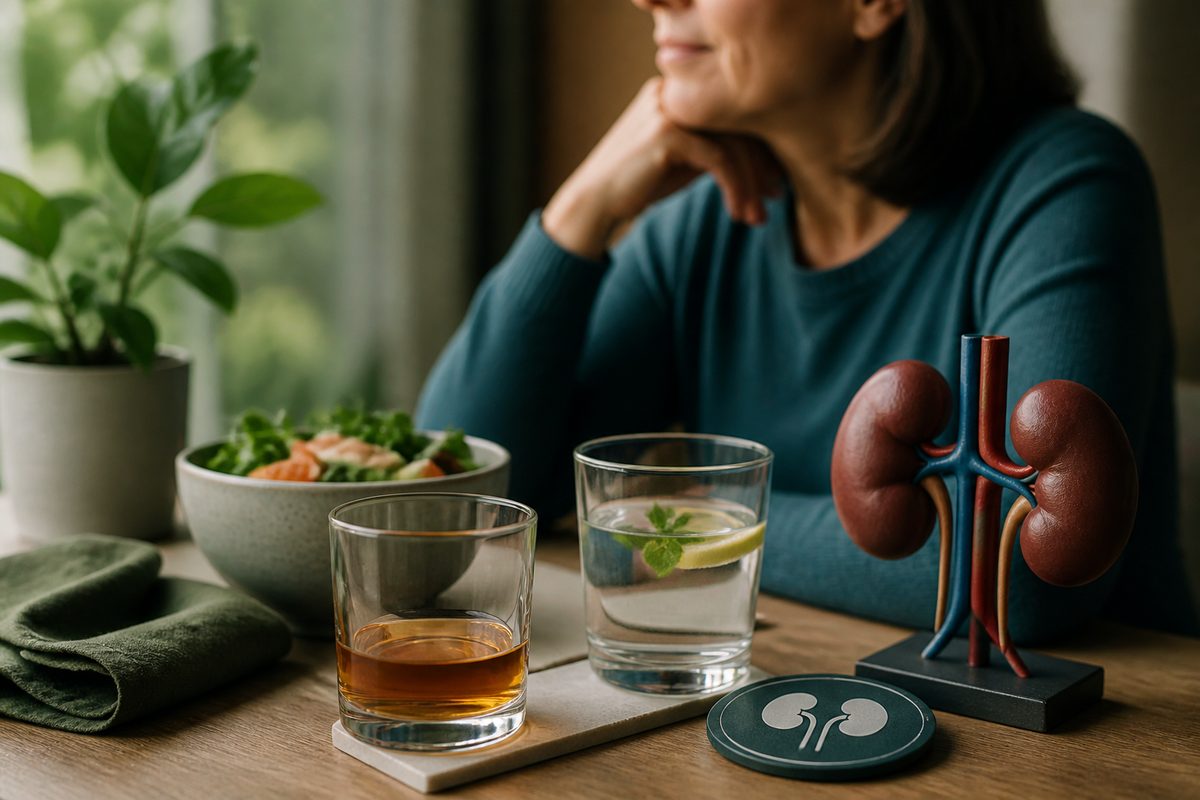

Is Alcohol Bad for Your Kidneys?
Related reading: Is Alcohol Bad for Your Kidneys?.

Key practical tips

Designed for quick scanning — what to order, what to avoid, sensible portions, common mistakes.

  • Read labels: sodium ≤ 0.3 g per 100 g (low) is the target
  • Cook from scratch when you can — it controls the hidden salt and phosphate
  • Personalise potassium and phosphate targets with your renal dietitian

Clinical guidance

TL;DR summary

For healthy adults, moderate coffee (up to about 400 mg caffeine — roughly 3–4 mugs — a day) is not linked to kidney damage and may even be associated with a small reduction in CKD risk. If you already have chronic kidney disease, the sensible amount is usually 1–2 mugs a day, and depends on your blood pressure, potassium results and CKD stage. Coffee is rarely the main problem — uncontrolled blood pressure, dehydration and high overall potassium load matter more.

Key takeaways
  • Moderate coffee (≈ 200–400 mg caffeine/day) is not linked to kidney damage in healthy adults.
  • In early CKD (Stages 1–3), 1–2 mugs a day is usually fine if blood pressure and potassium are well controlled.
  • Coffee contains ~100–150 mg potassium per mug — relevant in CKD Stage 4–5, on dialysis, or on ACE inhibitors/ARBs.
  • Coffee does not generally raise kidney-stone risk; low fluid intake and high oxalate do.
  • Decaf removes the caffeine but not the potassium — moderation still applies.
  • Stopping suddenly can cause withdrawal headache — taper over 1–2 weeks if cutting down.
Kidney Diet & Nutrition Considerations

On a kidney-friendly diet, single foods matter less than the overall pattern. Build meals around vegetables, lower-potassium fruit, whole grains, sensible protein and olive oil, and watch the three usual suspects — salt, phosphate additives and oversized portions of very high-potassium foods. Targets are individual and should be confirmed with your renal team.

Foods to prioritise

  • Vegetables and lower-potassium fruit at every meal
  • Whole grains: oats, basmati rice, pasta, wholegrain bread
  • Lean protein in modest portions: fish, chicken, eggs, tofu
  • Extra virgin olive oil, herbs and spices for flavour

Foods to limit

  • Added salt and salty sauces
  • Processed meats and foods with phosphate additives (E338–E452)
  • Very large portions of bananas, oranges, potatoes if potassium is rising

Potassium, phosphate and protein needs vary between individuals — please confirm personal targets with your renal team or dietitian. Browse the Kidney Diet Hub for more guides in this cluster.

Frequently asked questions

Is coffee bad for your kidneys?

For most adults with healthy kidneys, moderate coffee (around 3–4 cups, or up to ~400 mg caffeine per day) is not linked to kidney damage and may be associated with a small reduction in chronic kidney disease (CKD) risk. The picture changes if you already have CKD, high blood pressure that is hard to control, kidney stones, or take certain medicines — then caffeine, potassium and oxalate in coffee matter more and the sensible amount is usually lower.

How much coffee is safe with CKD?

Most UK renal dietitians treat 1–2 standard mugs (about 200–400 ml) of filter or instant coffee per day as a reasonable starting point in early CKD (Stages 1–3), provided blood pressure, potassium and phosphate are well controlled. From Stage 4 onwards, or on dialysis, the amount is more individualised — your renal team will factor in your potassium results, fluid allowance and overall caffeine intake.

Does coffee raise potassium in kidney disease?

Yes — coffee contains about 100–150 mg of potassium per mug, and several large mugs a day can add up, especially if you also eat other high-potassium foods or take an ACE inhibitor, ARB or potassium-sparing diuretic. In advanced CKD (Stage 4–5) and on dialysis this is a real consideration. If your latest potassium result was ≥ 5.5 mmol/L, ask your renal team before increasing coffee intake.

Can coffee cause kidney stones?

Standard black coffee is not a major driver of calcium-oxalate kidney stones for most people; observational studies actually suggest coffee drinkers may have a slightly lower stone risk. Risk goes up if total fluid intake is low, you add lots of milk to many cups (extra calcium and oxalate exposure), or you are prone to oxalate stones — in which case a renal dietitian should personalise your intake.

Is decaf better for the kidneys?

Decaf still contains potassium (similar to regular coffee) but very little caffeine, so it is a useful option if your blood pressure or sleep is sensitive to caffeine. It is not automatically 'kidney-friendly' in unlimited amounts — the potassium and any added milk still count.

What about espresso, cappuccino and instant coffee?

A single espresso shot (~30 ml) gives you less liquid and less potassium than a mug of filter coffee, but a similar caffeine hit. Milky drinks (latte, cappuccino, flat white) add potassium and phosphate from milk — usually fine in early CKD, but worth counting if you are on a low-potassium or low-phosphate plan. Instant coffee is broadly comparable to filter coffee for caffeine and potassium per cup.

Should I cut out coffee if I have CKD?

For most people with early-stage CKD, completely cutting coffee is not necessary or evidence-based. Stable blood pressure, sensible portions and good total fluid intake usually matter more than the choice between coffee and tea. Stopping suddenly can cause caffeine-withdrawal headache and a short-term blood-pressure dip — if you want to cut down, taper over 1–2 weeks.

What foods are best for kidney health?

A kidney-friendly diet centres on vegetables, lower-potassium fruit (apples, pears, berries), whole grains (oats, basmati rice, pasta), sensible portions of fish, eggs or lean meat, beans and lentils in modest portions, and olive oil as the main cooking fat — broadly a Mediterranean pattern with reduced salt.

Nutritional challenges in kidney disease

Many people living with kidney disease have to limit foods because of potassium, phosphate, diabetes, dialysis, appetite changes or simply the time it takes to cook from scratch every day. That can make it harder to keep daily nutrition balanced — particularly for vitamins and minerals that food alone may not fully cover.

Kidney Vitality is a UK-formulated daily nutritional support product designed by Consultant Nephrologist Professor Mohammed Mahdi Althaf with renal nutrition in mind from the start. It keeps doses moderate, leaves out added potassium, phosphate and magnesium, and avoids megadose vitamin A — sitting alongside a kidney-friendly diet, not replacing it.

Why Kidney Vitality fits this need

Built around UK renal guidance

Aligned with NICE NG203, KDIGO 2024 and KDOQI 2020 — the same guidelines UK renal teams use.

Designed by a UK Consultant Nephrologist

Formulated and reviewed by Professor Mohammed Mahdi Althaf (GMC 7216325).

Evidence-based by design

No added potassium, phosphate or magnesium; moderate vitamin C and D3 dosing.

Designed by a UK Consultant Nephrologist

Ready to support your kidney health?

If you have been researching kidney health, supplements, CKD nutrition or kidney-friendly living, Kidney Vitality was developed specifically around those principles by Professor Mohammed Mahdi Althaf (GMC 7216325). Nephrologist Developed Daily Multivitamin.

  • No Added Potassium
  • No Added Phosphorus
  • No Added Iron
  • UK Manufactured
  • One capsule daily
  • UK GMP — BRCGS, NSF GMP, Halal

✓ Free UK tracked delivery  ·  ✓ Delivered every 30 days  ·  ✓ Pause or cancel anytime  ·  ✓ Never run out

ComparisonKidney VitalityTypical high-street multivitamin
Added potassiumNoneOften included
Added phosphateNoneOften included (E338–E452)
Vitamin A (retinol)No megadoseOften high-dose retinol
Kidney-focused formulationYesNo — general population
Consultant Nephrologist involvementYes (GMC 7216325)No
UK GMP manufacturedYes (BRCGS, NSF GMP)Varies

Food supplement. Not a medicine and not a treatment for kidney disease. Speak with your GP, pharmacist or renal team before starting any new supplement, especially in advanced CKD, on dialysis, post-transplant, pregnant or breastfeeding.

Clinical reviewer

Professor Mohammed Mahdi Althaf

Consultant Nephrologist

Acute Physician

GMC 7216325

View Full Biography

Professor Mohammed Mahdi Althaf is a UK Consultant Nephrologist and Acute Physician with a special interest in chronic kidney disease, AKI prevention and renal nutrition. He combines hospital practice with patient education and clinical guidance review.

View professional profile →
View Credentials
  • MD
  • MSc
  • PgDip (Clin Ed)
  • FRCP
  • FHEA
  • FASN

About this article

Written for UK patients and based on:

  • NICE guidance
  • NHS resources
  • British Dietetic Association guidance
  • Kidney Care UK resources
View methodology

Each article is researched against current UK clinical guidance (NICE NG203, NG118, NG136), NHS patient resources, KDIGO and KDOQI international guidelines, and the British Dietetic Association Renal Nutrition Group. Drafts are written by the Kidney Vitality editorial team and reviewed by a UK Consultant Nephrologist before publication. Content is reviewed on a rolling basis and updated when guidance changes.

Editorial standards

  • Clinically reviewed
  • NHS-aligned
  • NICE-aligned
  • Evidence-based
  • Reviewed before publication
View full editorial process

Every article is researched and written by the Kidney Vitality editorial team using current UK clinical guidance (NICE NG203, NG118, NG136), NHS patient resources, KDIGO/KDOQI international guidelines, and British Dietetic Association renal nutrition guidance. Drafts are reviewed for clinical accuracy by Professor Mohammed Mahdi Althaf, MD, MSc, PgDip (Clin Ed), FRCP, FHEA, FASN (Consultant Nephrologist & Acute Physician, GMC 7216325) before publication. Content is updated when UK guidance changes.

References (4)View Sources
  1. NICE NG203: Chronic kidney disease — assessment and management
  2. KDIGO 2024 Clinical Practice Guideline for the Evaluation and Management of CKD
  3. KDOQI Clinical Practice Guideline for Nutrition in CKD: 2020 Update
  4. British Dietetic Association — Renal Nutrition Group

Medical disclaimer

This content is educational only and does not replace personalised medical advice.

Read full disclaimer

This page is general information, not personal medical advice. If you have chronic kidney disease, are on dialysis, have had a kidney transplant, are pregnant or breastfeeding, or take prescription medication, please confirm any supplement with your GP, pharmacist or renal team before starting.