Kidney Diet 7 min read·Updated 22 July 2026 Clinician-reviewed

Are Mushrooms Bad for Your Kidneys?

A UK Consultant Nephrologist on mushrooms in chronic kidney disease — variety-by-variety potassium and phosphate, why dried and stock-cube versions are different, and the vitamin D angle.

  • Clinically Reviewed
  • NHS & NICE Aligned
  • UK Evidence-Based
  • Last Reviewed 22 July 2026

Professor Mohammed Mahdi Althaf

Consultant Nephrologist & Acute Physician

View Credentials

Professor Mohammed Mahdi Althaf

MD, MSc, PgDip (Clin Ed), FRCP, FHEA, FASN

Consultant Nephrologist & Acute Physician · GMC 7216325

View profile →

Direct answer

Common UK mushrooms (white, chestnut) are moderate in potassium and phosphate, and fine in normal portions for most CKD patients. Portobello and shiitake are higher in potassium — limit if you have a strict K restriction. Dried mushrooms and mushroom stock cubes concentrate minerals and salt; use sparingly.

Key recommendation: White/chestnut mushrooms: ~ 300 mg K per 100 g — moderate.

Quick answer

✓ Best choices

  • Vegetables and lower-potassium fruit at every meal
  • Whole grains: oats, basmati rice, pasta, wholegrain bread
  • Lean protein in modest portions: fish, chicken, eggs, tofu
  • Extra virgin olive oil, herbs and spices for flavour

✓ Foods to limit

  • Added salt and salty sauces
  • Processed meats and foods with phosphate additives (E338–E452)
  • Very large portions of bananas, oranges, potatoes if potassium is rising

Key takeaway

Common UK mushrooms (white, chestnut) are moderate in potassium and phosphate, and fine in normal portions for most CKD patients. Portobello and shiitake are higher in potassium — limit if you have a strict K restriction. Dried mushrooms and mushroom stock cubes concentrate minerals and salt; use sparingly.

Who should be cautious

People on dialysis, post-transplant, pregnant or breastfeeding, or taking prescription medication — confirm with your renal team before changes.

Are Mushrooms Bad for Your Kidneys?

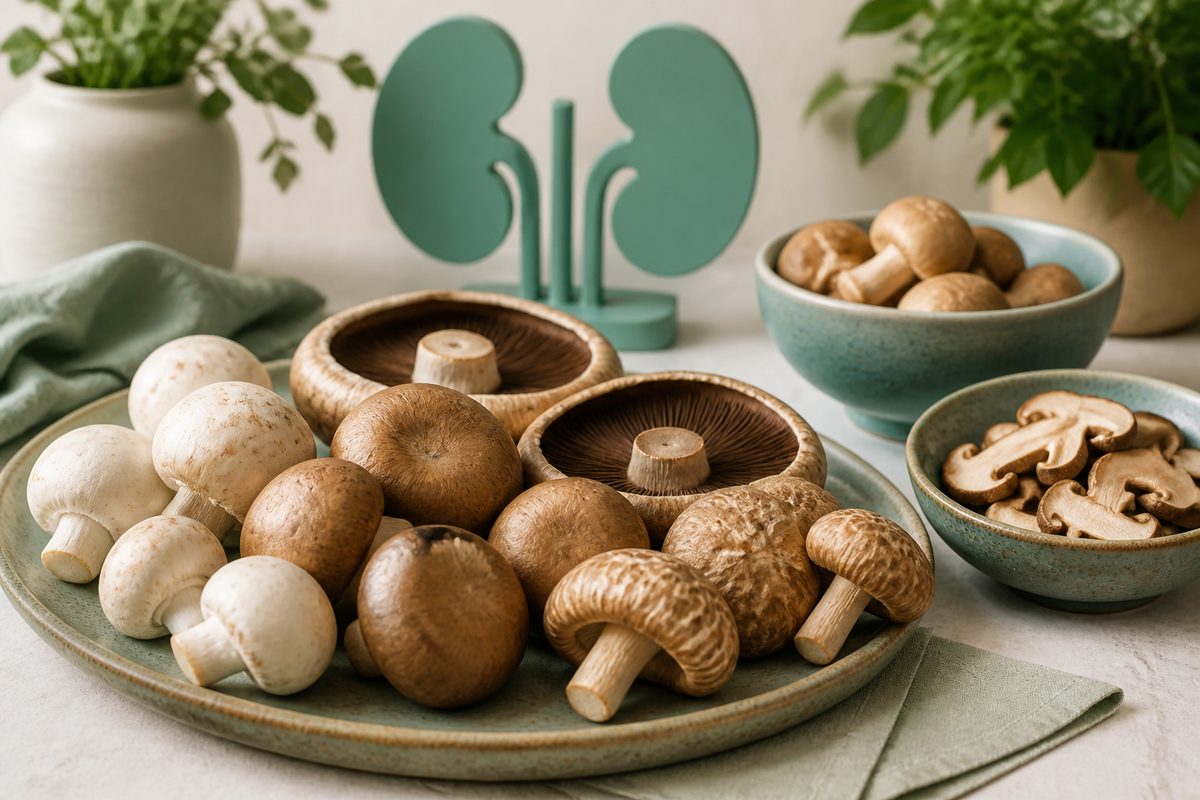
Mineral content by variety (per 100 g cooked)

  • White button: ~ 300 mg K, ~ 90 mg P
  • Chestnut: ~ 320 mg K, ~ 100 mg P
  • Portobello: ~ 440 mg K, ~ 120 mg P
  • Shiitake (cooked fresh): ~ 320 mg K, ~ 75 mg P
  • Oyster: ~ 230 mg K, ~ 100 mg P
  • Dried porcini (10 g reconstituted): ~ 200 mg K — small portion but concentrated

For reference a renal potassium restriction is often < 2 g/day; a 100 g mushroom portion uses 10–25% of that.

Why mushroom phosphate is less worrying than you'd expect

Phosphate from plants and fungi is bound in less bio-available forms (phytate, organic phosphate) and only about 40–50% is absorbed in the gut. Additive phosphate in processed food (E338, E450, E452) is 90–100% absorbed. So even though mushrooms list ~ 90 mg phosphate per 100 g on a nutrient database, the effective load on serum phosphate is much smaller than the number suggests. This is consistent with KDIGO 2024 guidance favouring plant-forward eating in CKD.

Practical guidance

  • A typical 80 g mushroom portion is fine in most CKD diets.
  • If potassium is restricted: stick to white/chestnut and keep to one portion per meal.
  • Use fresh garlic, herbs and black pepper to flavour mushrooms — avoid stock cubes.
  • UV-treated 'vitamin D' mushrooms are useful but not a substitute for a measured vitamin D dose.
  • Dried mushrooms are flavour-dense — use small amounts.
Are Beans & Pulses Bad for Your Kidneys?
Related reading: Are Beans & Pulses Bad for Your Kidneys?.

Key practical tips

Designed for quick scanning — what to order, what to avoid, sensible portions, common mistakes.

  • Read labels: sodium ≤ 0.3 g per 100 g (low) is the target
  • Cook from scratch when you can — it controls the hidden salt and phosphate
  • Personalise potassium and phosphate targets with your renal dietitian

Clinical guidance

TL;DR summary

Common UK mushrooms (white, chestnut) are moderate in potassium and phosphate, and fine in normal portions for most CKD patients. Portobello and shiitake are higher in potassium — limit if you have a strict K restriction. Dried mushrooms and mushroom stock cubes concentrate minerals and salt; use sparingly.

Key takeaways
  • White/chestnut mushrooms: ~ 300 mg K per 100 g — moderate.
  • Portobello/shiitake: higher K (~ 400–500 mg).
  • Plant-phosphate, ~ 40–50% absorbed — favourable.
  • UV mushrooms provide some vitamin D2.
  • Mushroom stock cubes are very high in salt.
Kidney Diet & Nutrition Considerations

On a kidney-friendly diet, single foods matter less than the overall pattern. Build meals around vegetables, lower-potassium fruit, whole grains, sensible protein and olive oil, and watch the three usual suspects — salt, phosphate additives and oversized portions of very high-potassium foods. Targets are individual and should be confirmed with your renal team.

Foods to prioritise

  • Vegetables and lower-potassium fruit at every meal
  • Whole grains: oats, basmati rice, pasta, wholegrain bread
  • Lean protein in modest portions: fish, chicken, eggs, tofu
  • Extra virgin olive oil, herbs and spices for flavour

Foods to limit

  • Added salt and salty sauces
  • Processed meats and foods with phosphate additives (E338–E452)
  • Very large portions of bananas, oranges, potatoes if potassium is rising

Potassium, phosphate and protein needs vary between individuals — please confirm personal targets with your renal team or dietitian. Browse the Kidney Diet Hub for more guides in this cluster.

Frequently asked questions

Are mushrooms bad for your kidneys?

Common UK mushrooms (white, chestnut) are moderate in potassium (~ 320 mg per 100 g raw) and moderate in phosphate. In normal portions they're fine for most CKD patients, including stage 3. Dried or concentrated mushroom products (dried porcini, mushroom stock cubes) are much higher per gram.

Which mushrooms are highest in potassium?

Portobello and shiitake top the list (~ 400–500 mg K per 100 g cooked). White button and chestnut are lower (~ 300 mg). Dried mushrooms concentrate everything — 10 g dried can equal 100 g fresh.

Do mushrooms contain phosphate?

Yes — about 90 mg phosphate per 100 g, which is moderate. Importantly this is natural plant-bound phosphate (absorbed at ~ 40–50%) rather than the highly absorbed additive phosphate in processed food. A normal mushroom portion is not a phosphate problem.

Can mushrooms give me vitamin D?

UV-treated mushrooms (sold as 'vitamin D mushrooms' in supermarkets) contain vitamin D2 — useful but less potent than D3. They're a fine occasional source but won't replace a vitamin D supplement if you're deficient. Most CKD patients need a checked vitamin D level and an appropriate dose.

Are mushroom stock cubes OK?

Generally no — stock cubes (mushroom, vegetable or any other) are very high in salt (often > 50% sodium chloride). Use fresh mushrooms or a low-sodium stock instead.

What foods are best for kidney health?

A kidney-friendly diet centres on vegetables, lower-potassium fruit (apples, pears, berries), whole grains (oats, basmati rice, pasta), sensible portions of fish, eggs or lean meat, beans and lentils in modest portions, and olive oil as the main cooking fat — broadly a Mediterranean pattern with reduced salt.

Nutritional challenges in kidney disease

Many people living with kidney disease have to limit foods because of potassium, phosphate, diabetes, dialysis, appetite changes or simply the time it takes to cook from scratch every day. That can make it harder to keep daily nutrition balanced — particularly for vitamins and minerals that food alone may not fully cover.

Kidney Vitality is a UK-formulated daily nutritional support product designed by Consultant Nephrologist Professor Mohammed Mahdi Althaf with renal nutrition in mind from the start. It keeps doses moderate, leaves out added potassium, phosphate and magnesium, and avoids megadose vitamin A — sitting alongside a kidney-friendly diet, not replacing it.

Why Kidney Vitality fits this need

Built around UK renal guidance

Aligned with NICE NG203, KDIGO 2024 and BDA renal potassium/phosphate guidance.

Designed by a UK Consultant Nephrologist

Formulated and reviewed by Professor Mohammed Mahdi Althaf (GMC 7216325).

Evidence-based by design

No added potassium, phosphate or magnesium; sensible vitamin doses.

Designed by a UK Consultant Nephrologist

Ready to support your kidney health?

If you have been researching kidney health, supplements, CKD nutrition or kidney-friendly living, Kidney Vitality was developed specifically around those principles by Professor Mohammed Mahdi Althaf (GMC 7216325). Nephrologist Developed Daily Multivitamin.

  • No Added Potassium
  • No Added Phosphorus
  • No Added Iron
  • UK Manufactured
  • One capsule daily
  • UK GMP — BRCGS, NSF GMP, Halal

✓ Free UK tracked delivery  ·  ✓ Delivered every 30 days  ·  ✓ Pause or cancel anytime  ·  ✓ Never run out

ComparisonKidney VitalityTypical high-street multivitamin
Added potassiumNoneOften included
Added phosphateNoneOften included (E338–E452)
Vitamin A (retinol)No megadoseOften high-dose retinol
Kidney-focused formulationYesNo — general population
Consultant Nephrologist involvementYes (GMC 7216325)No
UK GMP manufacturedYes (BRCGS, NSF GMP)Varies

Food supplement. Not a medicine and not a treatment for kidney disease. Speak with your GP, pharmacist or renal team before starting any new supplement, especially in advanced CKD, on dialysis, post-transplant, pregnant or breastfeeding.

Clinical reviewer

Professor Mohammed Mahdi Althaf

Consultant Nephrologist

Acute Physician

GMC 7216325

View Full Biography

Professor Mohammed Mahdi Althaf is a UK Consultant Nephrologist and Acute Physician with a special interest in chronic kidney disease, AKI prevention and renal nutrition. He combines hospital practice with patient education and clinical guidance review.

View professional profile →
View Credentials
  • MD
  • MSc
  • PgDip (Clin Ed)
  • FRCP
  • FHEA
  • FASN

About this article

Written for UK patients and based on:

  • NICE guidance
  • NHS resources
  • British Dietetic Association guidance
  • Kidney Care UK resources
View methodology

Each article is researched against current UK clinical guidance (NICE NG203, NG118, NG136), NHS patient resources, KDIGO and KDOQI international guidelines, and the British Dietetic Association Renal Nutrition Group. Drafts are written by the Kidney Vitality editorial team and reviewed by a UK Consultant Nephrologist before publication. Content is reviewed on a rolling basis and updated when guidance changes.

Editorial standards

  • Clinically reviewed
  • NHS-aligned
  • NICE-aligned
  • Evidence-based
  • Reviewed before publication
View full editorial process

Every article is researched and written by the Kidney Vitality editorial team using current UK clinical guidance (NICE NG203, NG118, NG136), NHS patient resources, KDIGO/KDOQI international guidelines, and British Dietetic Association renal nutrition guidance. Drafts are reviewed for clinical accuracy by Professor Mohammed Mahdi Althaf, MD, MSc, PgDip (Clin Ed), FRCP, FHEA, FASN (Consultant Nephrologist & Acute Physician, GMC 7216325) before publication. Content is updated when UK guidance changes.

References (4)View Sources
  1. NICE NG203: Chronic kidney disease — assessment and management
  2. KDIGO 2024 Clinical Practice Guideline for the Evaluation and Management of CKD
  3. KDOQI Clinical Practice Guideline for Nutrition in CKD: 2020 Update
  4. British Dietetic Association — Renal Nutrition Group

Medical disclaimer

This content is educational only and does not replace personalised medical advice.

Read full disclaimer

This page is general information, not personal medical advice. If you have chronic kidney disease, are on dialysis, have had a kidney transplant, are pregnant or breastfeeding, or take prescription medication, please confirm any supplement with your GP, pharmacist or renal team before starting.