If you've searched "what vitamins are good for kidneys" or "what is the best vitamin for kidneys", the honest UK answer is: there is no single "kidney vitamin" that fixes everything. There are, however, a handful of vitamins where the evidence — and NHS guidance — is clear.
The vitamins UK guidance actually backs
1. Vitamin D — the one almost every adult should consider
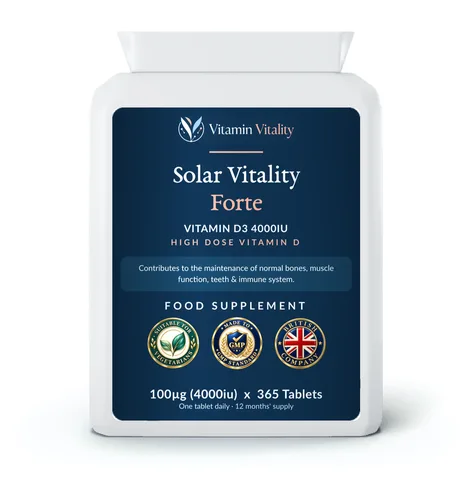
The NHS recommends a daily 10 µg (400 IU) vitamin D supplement for all UK adults during autumn and winter, because UK sunlight is too weak to make enough. The kidneys are responsible for the final activation of vitamin D — making it especially relevant for kidney health.
2. B-complex (folate, B6, B12)
Water-soluble B vitamins are commonly low in chronic kidney disease, particularly in dialysis patients. Moderate doses of folate, B6 and B12 are generally well tolerated and frequently included in UK renal vitamins (Renavit, Dialyvit) and evidence-based multivitamins.
3. Vitamin C — at sensible doses
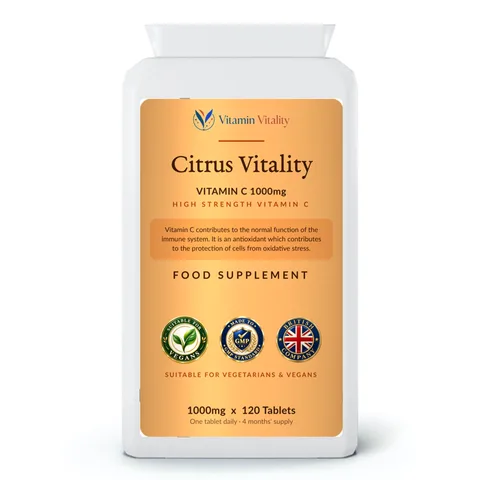
60–90 mg per day supports collagen, iron absorption and immune function without the oxalate stone risk associated with megadoses above 1,000 mg.
4. Vitamin K — usually from food
Found in leafy greens. Low-dose supplements are generally fine, but anyone on warfarin should keep their vitamin K intake stable rather than swinging up and down.
Vitamins to be careful with
- Vitamin A (retinol) — accumulates in CKD; avoid high-dose supplements.
- High-dose vitamin C (above 1,000 mg) — kidney stone risk.
- High-dose vitamin E — not recommended for the general UK adult population.
Minerals that matter alongside the vitamins
- Iron — only if deficient on a blood test.
- Selenium — small amounts from food; UK soils are low.
- Zinc — moderate doses only.
- Potassium and phosphate — should be absent from any evidence-based supplement.
What to look for on the label
- Doses close to UK RNI — not 5,000% of RNI.
- Vitamin D included (especially in winter).
- No added potassium or phosphate.
- Low or no vitamin A (retinol).
- UK manufactured in a GMP-certified facility.
Bottom line
The best vitamins for kidney health in the UK are vitamin D, the B-complex group and modest vitamin C — all at sensible doses, with no added potassium or phosphate. Anything labelled "kidney detox" or "5,000% RNI" is a marketing claim, not a kidney benefit.
What UK guidance says about vitamin D
The NHS recommends that all adults in the UK consider a daily 10 microgram (400 IU) vitamin D supplement between October and early March, because sunlight at our latitude is too weak to make enough through the skin. People with darker skin, those who cover up for cultural reasons, and anyone housebound are advised to take it year-round.
In chronic kidney disease (CKD), as kidney function falls, the kidneys become less able to convert storage vitamin D (25-hydroxyvitamin D) into its active hormone form (calcitriol). NICE NG203 recommends checking 25-hydroxyvitamin D in people with CKD and supplementing with cholecalciferol if deficient, before considering activated forms like alfacalcidol.
Safe doses in CKD
- Maintenance: 10 µg (400 IU) daily, matching the NHS recommendation.
- Replacement: 20–50 µg (800–2000 IU) daily for several weeks under GP supervision.
- High-dose loading regimens are prescription-only in CKD.
Vitamin C, oxalate and the kidneys
Vitamin C is water-soluble, so the body cannot store large amounts. The UK Reference Nutrient Intake (RNI) is 40 mg/day for adults — easily met from one orange, a kiwi or a portion of peppers. Megadose vitamin C (1000 mg or more) is metabolised to oxalate, and several large cohorts have linked high-dose vitamin C supplementation to a higher risk of calcium-oxalate kidney stones.
Sensible UK ceilings
- Healthy adults: up to 200 mg/day from supplements is well tolerated.
- Adults with a stone history: stay near the RNI; prefer food sources.
- People with CKD: avoid megadoses; renal dietitians typically cap intake at 60–100 mg/day.
Practical UK checklist for What Vitamins Are Good for Your Kidneys? A UK Evidence-Based Guide
- Know your numbers. Ask your GP for your most recent eGFR, urine ACR, blood potassium, phosphate, bicarbonate and 25-OH vitamin D.
- Audit what you already take. Lay every supplement, herbal product and sports nutrition pot on the kitchen table. List actives by dose, not by %NRV.
- Cross-check against UK guidance. NICE NG203 for CKD, NG118 for stones, NG136 for hypertension; NHS condition pages for general nutrition.
- Book a pharmacist medicines review. Free on the NHS in England (the New Medicine Service and Structured Medication Reviews) and in equivalent schemes across Scotland, Wales and Northern Ireland.
- Re-evaluate every 3–6 months. Kidney function changes; what was right last year may not be right today.
Common myths vs UK clinical reality
- Myth: 'Kidney cleanses flush toxins.' Reality: The kidneys are the cleansing organ; no UK clinical body endorses 'cleanse' supplements, and several have caused acute kidney injury.
- Myth: 'More vitamins is always better.' Reality: High-dose vitamin A, vitamin C and selenium are linked to harm in CKD; safety lies inside the UK RNI ranges.
- Myth: 'Natural means safe.' Reality: Several herbals (Aristolochia, high-dose liquorice, comfrey) cause kidney injury. Look for MHRA Traditional Herbal Registration (THR) marks.
- Myth: 'Drink as much water as possible.' Reality: Pale-straw urine is the goal in early CKD; advanced CKD and dialysis often require fluid restriction.